
To Shift or To Close? How Lane Shifting Can Save Your Traffic Control Budget

123 TCP • August 6, 2026

Share this article

Road worker walking on wet pavement carrying orange traffic cones, reflective safety gear visible

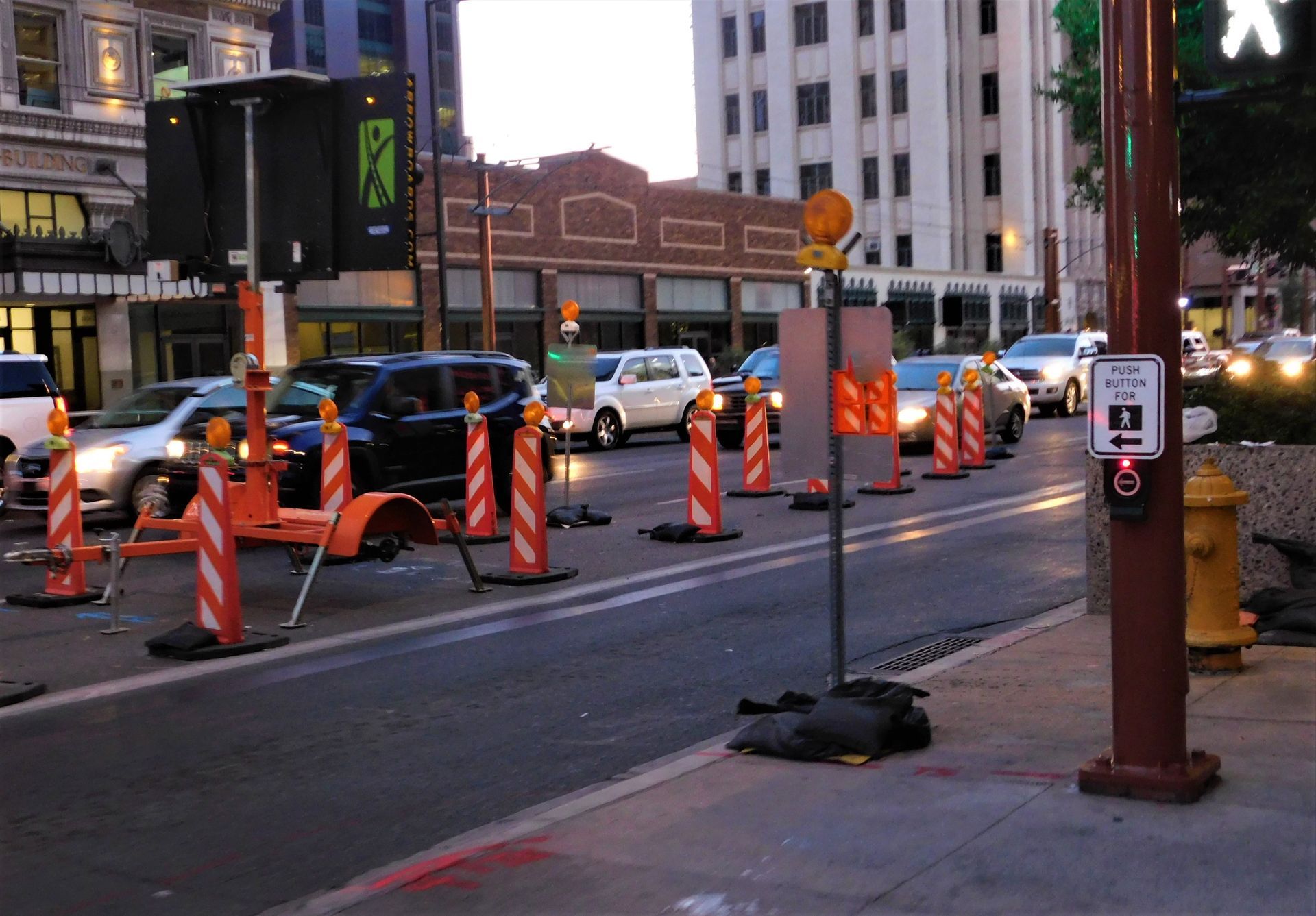
If you are a contractor, underground utility specialist, or project manager, you know that keeping your crew moving is everything. When a worksite eats into the roadway, you generally have two choices to manage the flow of vehicles: close the lane entirely and set up a flagger-controlled reverse lane, or shift the traveled lane around your site.


While full closures are common, shifting a traveled lane—without closing it—is often the preferred strategy to maintain continuous access, minimize public impact, and heavily reduce your daily flagging and labor costs.


However, before you assume you can just push traffic a few feet to the left and submit a sketch to the city, you need to understand the hidden spatial requirements that municipal reviewers are looking for. Here is what you need to know to get your encroachment permit approved without delay.

The Hidden Math Behind Transition Space

To successfully shift lanes, your site needs two things: the cross-section width to physically accommodate the shifted lanes, AND the longitudinal length to maintain compliant transitions (also known as tapers).


Governing agencies rely on the Manual on Uniform Traffic Control Devices (MUTCD) and localized city guidelines to dictate these lengths. As a general rule of thumb for low-speed 25 MPH roads, every 1 foot of lateral shift to the left or right requires roughly 10 feet of longitudinal transition space.


  • What that means for your site: If you need to shift a lane 12 feet over to bypass your work area, you could require an additional 120 feet of transition space on both sides of the work zone (to ease traffic around, and shift them back).

  • Higher speeds equal more space: If your project sits on an arterial road with a higher speed limit, the required longitudinal transition space will stretch even further. If you don't have this space mapped out accurately on your Traffic Control Plan, the city will kick it back.

Why Do Jurisdictions Require So Much Space?

When you are trying to squeeze a work zone into a tight city street, these taper requirements can feel excessive. But city reviewers demand this space for two very practical reasons:


  • Motorist Safety: It eases drivers into the shift smoothly and at a trajectory that matches their travel speed.

  • Accommodating Large Vehicles: It ensures large trucks—and vehicles towing trailers—can navigate the shift. Without an adequate taper, larger vehicles can't make tight transitions and might be forced into dangerous reverse maneuvers (like a 3-point turn) in the middle of a live road.

The Flagger Compromise

What happens if you simply don't have 240+ feet of total road space available to create these transitions? Some jurisdictions offer a compromise.


Reviewers may allow for shorter transitions if your plan includes dedicated flaggers who can temporarily hold traffic for larger vehicles that require reverse movements to navigate the shift. While this keeps traffic flowing and gets your permit approved in tight quarters, you do lose out on some of the financial benefits of the shift, as you are now paying for on-site flagging labor.

Actionable Advice For Your Next Project

When planning your next dig, sewer tie-in, or crane lift, take a hard look at the road space immediately surrounding your work zone. Take note of all available space—including parking lanes, shoulders, and the areas approaching and departing the site—to see if a traffic shift is a viable option. Accurately assessing your footprint early on can drastically change your traffic control strategy and save your budget.

Cut the Red Tape with 123TCP

At 123TCP, we know you aren't looking to buy extra construction hardware—you just want your permit approved so you can get to work. That is why we operate a direct-to-drafter marketplace.


We connect contractors, plumbers, tree trimmers, and crane operators directly with skilled, locally experienced drafters without any hassle. Because we strictly focus on professional plan drafting, we will never try to bundle unwanted contracting services or upsell you on physical signs, cones, or flaggers you don't need.


Got an urgent deadline or a stalled encroachment permit? We offer expedited turnaround options to get your compliant plan drafted, submitted, and approved fast.


Don't let municipal red tape keep your machinery standing idle.


Get Plans now and connect directly with a professional drafter who knows your city's exact rules and can calculate the perfect transition space for your site.

Frequently Asked Questions

  • What is the difference between shifting a lane and a flagger-controlled reverse lane?

    Shifting a lane keeps traffic continuously moving around the work site using tapers and channelizing devices. A flagger-controlled reverse lane requires stopping traffic in one direction while the opposite direction shares a single open lane, which forces you to pay for on-site flaggers to manage the alternating flow.

  • Where can I find the exact transition lengths required for my specific site?

    While the MUTCD provides federal baseline formulas based on speed limits and lane widths, local municipalities and state DOTs often have their own specific standards. The best way to ensure compliance without digging through municipal codes is to hire a drafter who is familiar with the localized requirements of the agency issuing your permit.

  • Can I just estimate the taper length on my plan to save time?

    No. Municipal reviewers will quickly reject plans that do not correctly calculate longitudinal transition tapers. Even small mathematical errors regarding transition space can cause multi-week revision delays. Using a platform like 123TCP ensures these calculations are handled by professionals correctly the first time.

Recent Posts

Toy cars and road signs surrounding a sketchpad with a drawn intersection on a blue background
By 123 TCP August 4, 2026
Stalled by municipal permit red tape? Discover who your Traffic Control Plan is really for, avoid costly revision cycles, and get approved faster with 123TCP.