
Demystifying the Encroachment Permit: What Contractors Need to Know

123 TCP • September 21, 2026

Share this article

Hand stamping a document on a desk beside a laptop, with warm blurred lights in the background

If you are a project manager or contractor just getting started on your first big project, you might be staring down a requirement from the city and asking yourself, "What exactly is an Encroachment Permit?"


At 123TCP, we know you didn't get into this business to shuffle paperwork. You usually only look for these answers because a city government or safety officer is demanding compliance, and you're likely already feeling the pressure of a tight schedule.


Let’s cut through the red tape and break down exactly what this permit is and how to get past this hurdle so you can break ground.

The Truth About the "Public Right of Way"

To understand the permit, you have to understand who owns the land. As Adam Freeland recently highlighted in a great breakdown of this topic:

"Just getting started with their first big new project, many project managers and contractors have to learn the hard way just 'what is an Encroachment Permit?' Everywhere that the public has regular access (often called the Public Right of Way, streets, sidewalks, parks, etc.) is most often owned and controlled by some form of government... These governments have a mandate to maintain reasonable public access, while working towards the overall public good."

When your project needs to use that public space in a way that hinders regular access—like digging up a road to access underground utilities, operating a crane, or tying into a sewer line—you are "encroaching." Therefore, you need permission from the city, county, or state that manages it.

What to Expect During the Permit Process

Every governing agency has its own unique rulebook, but here is what you will generally need to provide to get your Encroachment Permit approved:


  • Application & Fees: Expect a processing fee to cover the government's administrative work, and often a "usage fee" (essentially rent for the public space) based on how long and how much area your project requires.


  • Insurance & Bonding: You must prove you can protect the city and its infrastructure during your work.


  • Traffic & Pedestrian Control Plans: This is the big one. The city will not let you start work until you prove exactly how you will keep drivers, pedestrians, and your own crew safe while the right-of-way is obstructed.


  • Strict Timelines: Many permits are tied to specific dates and times. If your project gets delayed, you may have to resubmit your paperwork.

How 123TCP Speeds Up Your Permitting

We know dealing with municipal red tape is frustrating, especially when it holds up your crew. At 123TCP, our mission is to eliminate the friction of getting the Traffic Control Plans you need to secure that permit.


Instead of dealing with a traditional contracting firm that might try to upsell you on signs or flaggers you don't need, our direct-to-drafter marketplace connects you straight to the experts who draw the plans. We focus purely on drafting, which means we can offer expedited options to get your stalled project moving again, fast.


Ready to check "Traffic Control Plan" off your to-do list?


Get Plans Now

Frequently Asked Questions

  • What is an encroachment permit?

    An encroachment permit is official permission granted by a local or state government allowing a contractor, business, or individual to temporarily use or obstruct a public right-of-way (such as a street, sidewalk, or alley) for a project or event.

  • Why do I need a Traffic Control Plan (TCP) for an encroachment permit?

    Municipalities require a Traffic Control Plan to ensure public safety. Because your project will obstruct normal traffic or pedestrian flow, the city needs a drafted, compliant blueprint showing exactly how you will safely detour vehicles, protect pedestrians, and shield your work zone before they will issue the permit.

  • How much does an encroachment permit cost?

    The cost varies significantly by municipality. It typically includes a standard processing fee for the application, plus a usage fee that is calculated based on the square footage of the public space you are occupying and the total duration of your project.

  • How can I get my encroachment permit approved faster?

    The most common cause of permit delays is submitting incorrect or non-compliant safety documents. You can speed up the process by ensuring your Traffic Control Plans are drafted by professionals who understand local municipal codes. Using a service like 123TCP provides expedited plan options so your application isn't held up by drafting delays.

Recent Posts

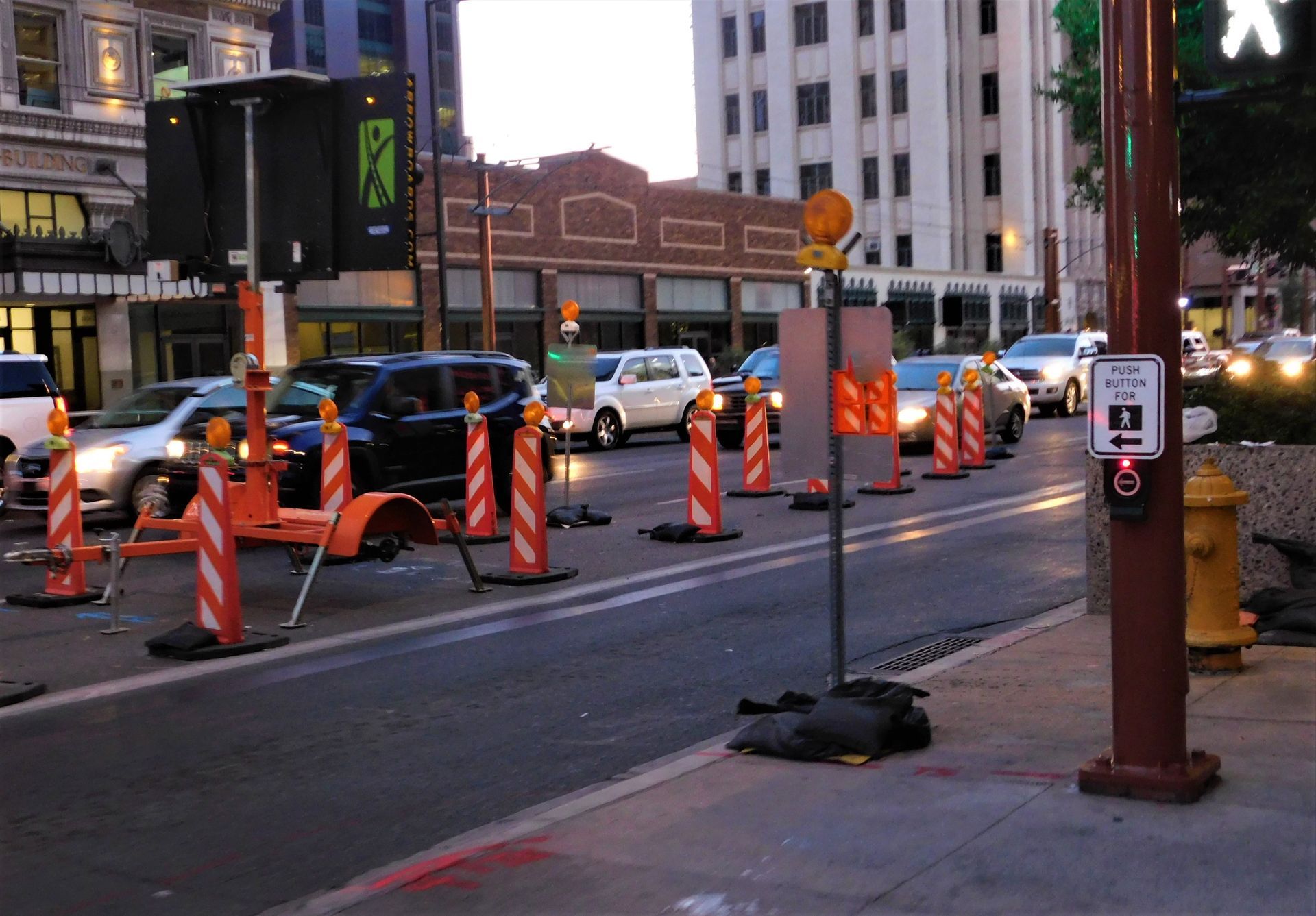
Downtown street with orange traffic cones, cars, and a roadwork sign at dusk
By 123 TCP September 10, 2026
Struggling to get your sidewalk closure or pedestrian diversion approved? Learn how to navigate municipal TCP requirements and get your permits approved fast.
Aerial view of a suburban four-way intersection with houses, trees, lawns, and parked cars.
By 123 TCP August 31, 2026
Need a Traffic Control Plan for public right-of-way on private property? Learn how to navigate double the red tape, avoid delays, and get your TCP approved fast.

Worker in reflective gear walking on wet pavement carrying two orange traffic cones
By 123 TCP August 16, 2026
Learn when to use lane shifting instead of full closures for your next construction project. Discover how proper taper lengths save time and flagging costs.

Toy cars and road signs surrounding a sketchpad with a drawn intersection on a blue background
By 123 TCP August 4, 2026
Stalled by municipal permit red tape? Discover who your Traffic Control Plan is really for, avoid costly revision cycles, and get approved faster with 123TCP.